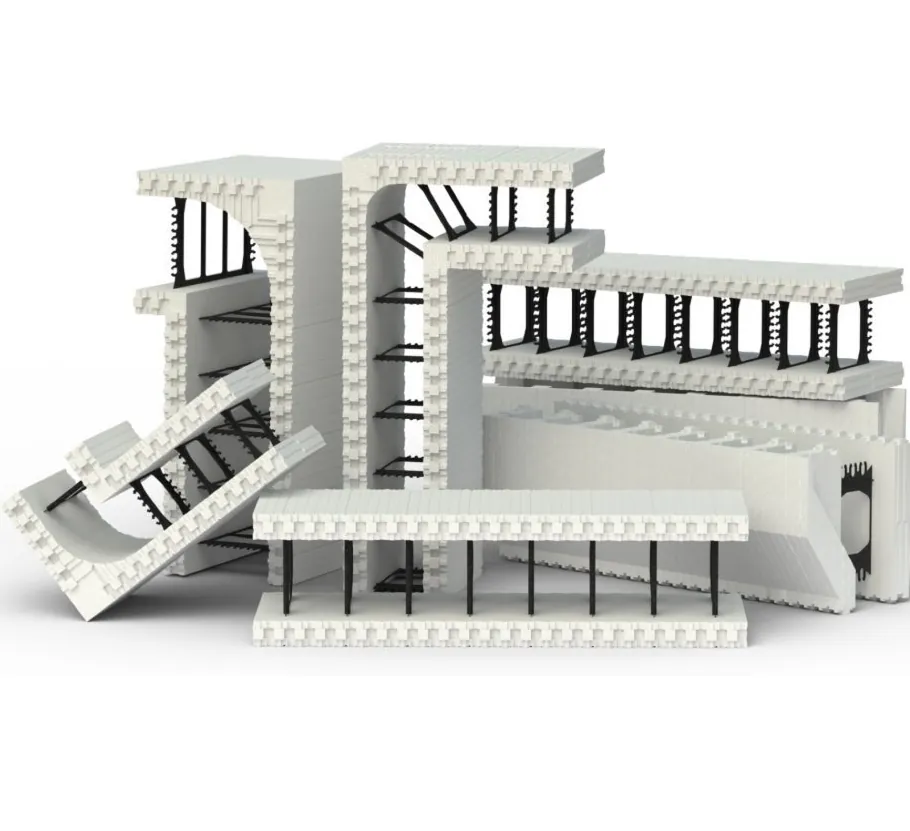
An ICF wall is two layers of rigid foam holding the formwork for a poured, steel-reinforced concrete core. Once the pour cures, the foam stays on the wall — permanent insulation on both faces, with the concrete doing the structural work. It is one of the few wall systems that delivers strength, insulation, and air-tightness in a single trade.
What ICF is
The forms ship as interlocking blocks. The crew stacks them in courses, drops in the reinforcing steel, and pours the cells with concrete. The foam shells stay in place; finishes go straight over them. There is no separate cavity insulation, no sheathing-and-batten layering, no thermal bridge across the stud line.
The reason it has become a default choice on our projects is not the look of the finished wall — you cannot tell ICF from any other wall when the drywall is up. It is what the wall does in the years that follow.
Where it earns its place
ICF earns its specification in places where ordinary framing is asked to do too many jobs at once. Hurricane country. Tornado alley. Seismic zones. Sites where the design calls for very tall single-storey volumes, or for floor plates that span without an interior bearing wall. The concrete core handles loads that wood framing would have to be reinforced for; the foam handles the insulation problem that masonry would have to be retrofitted for.
In our Florida coastal work the deciding factor is wind. In our Texas inland work the deciding factor is summer cooling load. Either way the answer ends up being the same wall.
ICF is the rare wall system that handles structure, insulation, and air-tightness in a single trade — which is the same thing as saying it handles three sources of risk on one set of shop drawings. — UHUSA practice notes
Thermal & acoustic performance
Continuous foam on both faces eliminates the thermal bridges that punish stud-framed exteriors. Effective R-values commonly land in the R-22 to R-28 range, and the air-tightness of a poured wall is closer to a passive-house assembly than to a framed one. The practical result is HVAC equipment that can be sized down, run less, and last longer.
The same mass that gives thermal performance also gives acoustic isolation. STC ratings in the high 40s and low 50s are typical for an ICF exterior — street noise, lawn equipment, neighbouring construction, all reduced to background. It is a quality you notice on the first night, not at handover.
Sustainability
Concrete has a carbon problem on the way in, and a longevity benefit on the way out. ICF takes both seriously: lower lifetime energy consumption from the envelope offsets a meaningful share of the embodied carbon over a forty-year life, and the wall is fundamentally a long-life assembly — no insulation settling, no batten rot, no air-sealing degradation over time. On projects chasing LEED or similar certification, ICF tends to earn points across several categories at once.
Applications
We specify ICF for:
Walls and partitions. Standard exterior assemblies and interior walls where soundproofing or fire-rating matters. ICF blocks make the geometry simple; the concrete does the rest.
Basements. Below grade, ICF gives a moisture-resistant, insulated envelope without the layering and waterproofing rework that masonry assemblies need. The basement comes out comfortable, not the usual concrete box.
Multi-storey buildings. ICF scales to mid-rise residential and commercial. Acoustic isolation between units is excellent; seismic and wind performance are above what framed alternatives can offer.
Foundations and retaining walls. Where the wall is both structural and environmental — holding back earth, holding out water, holding in heat — the all-in-one assembly is the right tool.
For a project where ICF would be appropriate, the right conversation is the one that happens at design development, before the framing package is locked. Start a conversation.